
Welcome to the iPrepBuddy Monthly Newsletter!
Stay informed with the latest updates on our platform and the newest advancements in ophthalmology. This newsletter aims to keep you prepared for your upcoming exams.
by Dr Chloe Walugembe on 01/10/2026
Clinical Insight: Choroidal rupture
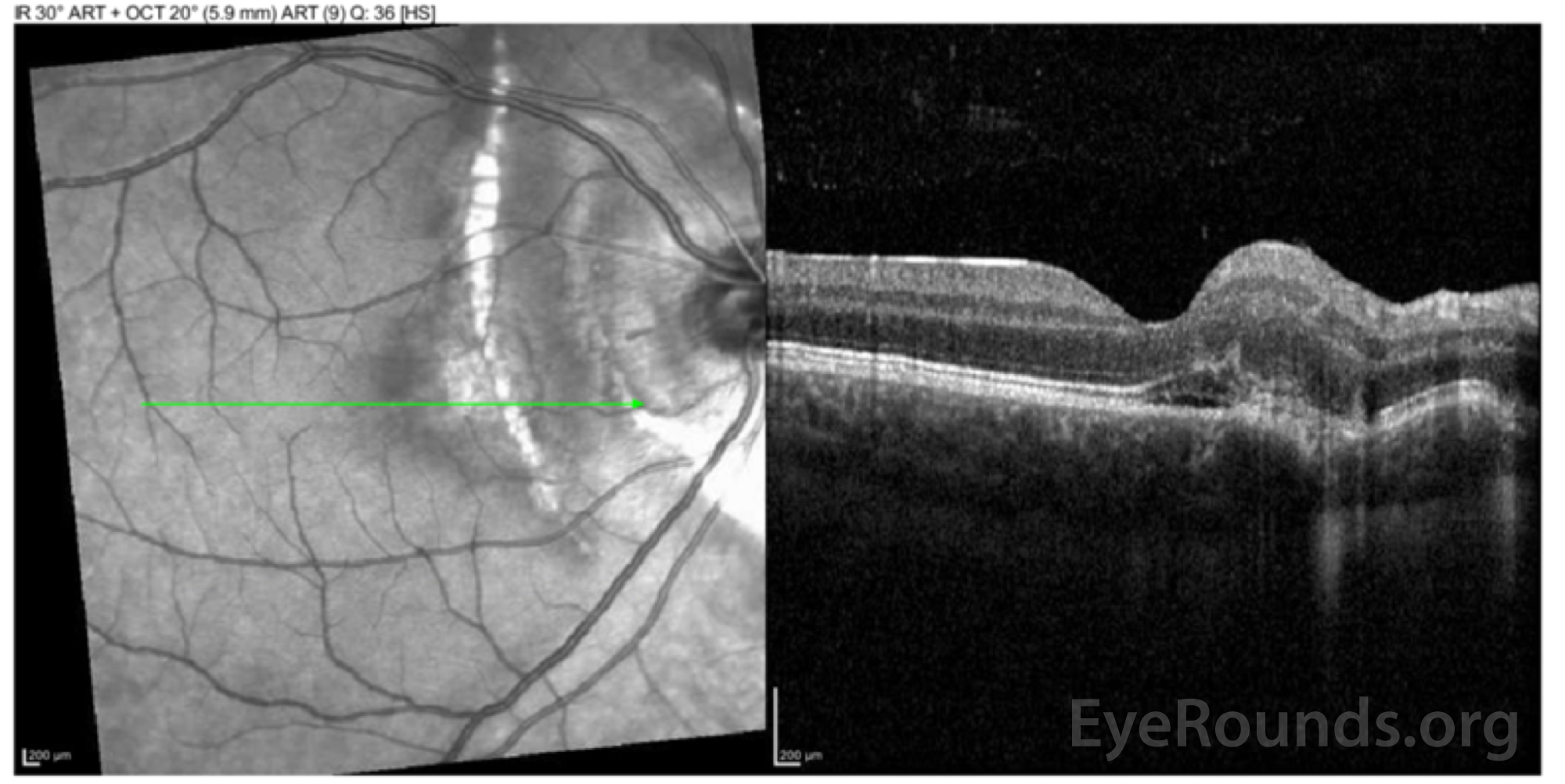
Figure 1: Infrared image showing a curved choroidal rupture around the optic disc. The OCT scan shows a break in the layers beneath the retina, with material collecting under the retina at the rupture site [1].
Choroidal rupture is a break in the retinal pigment epithelium, Bruch's membrane and choriocapillaris following blunt ocular trauma. It usually occurs indirectly as the globe compresses and the relatively inelastic Bruch's membrane tears, forming a crescent concentric to the optic disc. It appears as a white or yellow curvilinear lesion, often initially hidden by haemorrhage, and reduces vision when the fovea is involved. The rupture itself cannot be treated, but patients need monitoring for complications, particularly choroidal neovascularisation, which is treated with anti-vascular endothelial growth factor (anti-VEGF) injections[2].
Platform Updates
The iPrepBuddy team is offering a free 1:1 call to anyone applying for ST1 ophthalmology this cycle. To book one, sign up for the demo on our website, then email sean@iprepbuddy.com to request your call.
We are also updating our ST1 scenarios based on feedback from current ST1 trainees.
Updates in Ophthalmology
Ophthalmology ST1 2027 portfolio is out !! [3]
The 2027 Ophthalmology ST1 evidence folder and self-assessment framework are now published by NHS England South West (Severn), with applications expected to open around 22 October 2026.
Early vitrectomy shows promise in post-operative endophthalmitis — the EVIAN feasibility trial [4]
The UK multicentre EVIAN trial randomised 63 patients with postoperative exogenous endophthalmitis to early vitrectomy plus intravitreal antibiotics, or standard care (repeat intravitreal antibiotics with delayed vitrectomy where required). At 24 weeks, the early vitrectomy group gained a median 40 ETDRS letters versus 13 letters in the standard-care group, and retinal detachment was less frequent (6.7% vs 24%). The visual acuity difference wasn't statistically significant, but the trial confirms feasibility for a larger, definitive study. Current endophthalmitis management guidelines are still largely based on the Endophthalmitis Vitrectomy Study (1995), which only included post-cataract surgery cases[5].
GIRFT publishes national Best Practice Guidance for Glaucoma Services [6]
NHS England's Getting It Right First Time programme has published Best Practice Guidance for Glaucoma Services, backed by RCOphth, the College of Optometrists, RNIB, Glaucoma UK and the UK Ophthalmology Alliance. The guidance pushes for greater use of virtual clinics, risk-based follow-up and shared care between hospital eye services and community optometrists, with a focus on referral accuracy and prioritising patients at highest risk of progression — aimed at easing pressure on hospital eye services while preventing avoidable sight loss.
Upcoming Conferences
Eye Academy Conference – 18th Oct | London
United Kingdom & Éire Glaucoma Society (UKEGS) – 10th–11th Nov | Manchester
United Kingdom & Ireland Society of Cataract & Refractive Surgeons (UKISCRS) – 19th–20th Nov 2026 | London
Irish College of Ophthalmologists (ICO) Winter Meeting – 27th Nov | Dublin
Medical Ophthalmology Society of the United Kingdom (MOSUK) – 4th Dec | London
Medical Contact Lens and Ocular Surface Association (MCLOSA) Annual Scientific Meeting – abstract deadline 8th Jan 2027 | London